Showing posts with label digital texts. Show all posts

Sunday, June 3, 2012

Access and activity


I’ll be blogging in response to a webinar series
offered by connectedlearning.tv at the invitation of the National Writing Project’s Digital Is.


During S. Craig Watkins’ connectedlearning.tv session, he explained that Black and Hispanic teens spent more time on mobile devices than White teens. Watkins, a principal investigator of the Connected Learning Research Network and a teacher at the University of Texas, called this a “mobile paradox,” a seeming contradiction to the digital divide. Though they are more likely to live in homes without broadband access, Black and Hispanic teens are bridging the access gap using mobile devices.

A recent  Pew Internet study reports the same:
Among smartphone owners, young adults, minorities, those with no college experience, and those with lower household income levels are more likely than other groups to say that their phone is their main source of internet access.

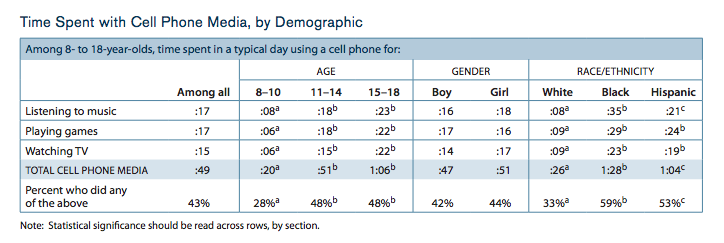
In the many links below the archived video of Watkins’ session on connectedlearning.tv is a link to the Kaiser Family Foundation’s Generation M2 study. As I read through that one, I found it curious that the study only categorized time spent with cell phone media three ways: listening to music, playing games, and watching TV. (Here’s the chart.)#
On the other hand, the study categorized computer use in eight ways. (Here’s that chart.)
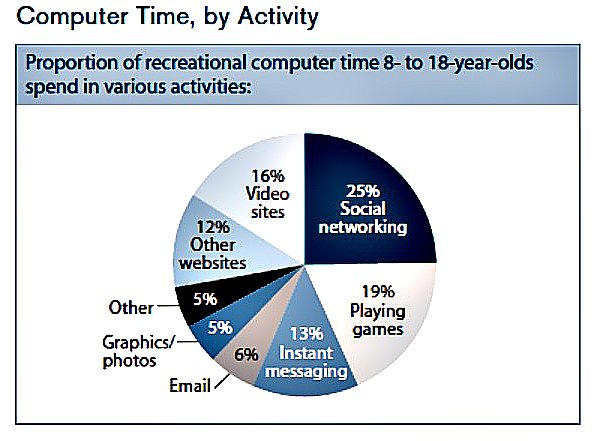


This raised a few questions for me. First, why paint such a limiting picture of mobile media use on cell phones when these devices support all of the practices attributed to computer time? Just by approaching the different devices this way, the report suggests a disparity of media practices that may not exist.

I also wondered, looking at this pie chart, how can researchers make the distinction between “social networking” and these other media practices, many of which take also take place on social networks. YouTube probably qualifies as a video site, but it also is a social network. On Facebook- the social network- users play games, instant message one another, and create, edit and share photos and videos. “Social networking” is such a general verb, that it really only identifies the platform on which teens might interact with peers and media.

Especially as teachers endeavor to explore interest-driven practices of youth with digital tools, we can continually refine how we examine those practices.

Resources: 
"Digital Differences." Pew Research Center's Internet & American Life Project. Web. 03 June 2012. <http://pewinternet.org/Reports/2012/Digital-differences/Overview.aspx>.

"Report: Generation M2: Media in the Lives of 8- to 18-Year-Olds - Kaiser Family Foundation." Kaiser Family Foundation. Web. 03 June 2012. .

Sunday, May 20, 2012

Two sites, two opportunities

  Recently, in a 12th grade English classroom, I asked students to navigate between two different types of sites while researching to prepare for debates. I wanted them to begin their research on the New York Times Room for Debate page, so I showed them how the site worked and asked them specifically to read the introduction of a high-interest topic. Next, they had to read each of the expert articles associated with the topic. A week or so later, I sent them to a different site, Debate.org. This time, I asked students to find examples of strong and weak online debates. Instead of explaining how the site worked, I asked them to explain it to me.
I liked the assignment because it moved us away from the familiar discourse about these types of sites, where we identify one as informal, and therefore bad, and one as a formal site from a reputable publisher, therefore good. Certainly, we needed college-bound seniors to know that they cannot cite Debate.org in their research papers. Also, they had to know that the authors selected by the New York Times had a certain amount of credibility deriving from this publication, if not for their credentials under their bylines.
     Rather than stopping here with our consideration of the sites, though, I hoped they would see that Debate.or is a social network where people engage in competitive debates of varying seriousness and political correctness. The New York Times, of course, is the New York Times. This online, 21st Century version of the venerable newspaper is increasingly participatory and has many elements of a social network, too. In the 12th grade classroom, we wanted students to see that the sites differ in the level to which they invite participation. If I read the New York Times and do not comment, vote or debate, I'm a reader. If I read Debate.org and I don't debate, comment or vote, I'm a noob, or a lurker.
    Something these seniors and I obseved in our work is that some participants on Debate.org formulate better arguments than the experts invited to write for the Times. Students would read some expert articles and come away with no more information about their topic. Ironically, some of the arguments on Debate.org proved to be models of strong inline citation and link students to credible research about their topics. Readers have to filter more strategically in Debate.org, lest they spend their time reading an informal debate that consists entirely of “Your momma” jokes. So, filtering strategies were key, as indicated in the reflection written by Jacob, a student who successfully navigated the site. He wrote:

While I was siphoning through the challenges, I have acquired a basic working knowledge of how the site works and what can be done with the site. During my search the most well supported debate was a debate arguing whether or not the Muslim religion endorsed terrorism. The least supported debate was a joke debate that lacked any real knowledge of the subject to be funny.

    His critical thinking helped me decide that the exploration of a social network had benefits and I was glad that our research and preparation for class debates took students to a virtual space not normally travelled in an English class.  

Sunday, February 26, 2012

Thinking collaboratively and creatively about digital texts and tools... #change11

Author: Samantha Penney, samantha.penney@gmail.com 
I recently read a Twitter feed discussion between educators about this graphic, which was published on the University of Southern Indiana's website. They were critical of this arrangement of tech tools, calling it "arbitrary foolishness" and generally "disappointing." I tended to agree, but the discussion brought me back to an article I read recently by Alice S. Horning, "The Psycholinguistics of Literacy in the Flat World," where she claims that our use of language is evolving, especially in digital environments and that texts themselves are going through an evolutionary process.

Her article reminded me of working with some high school seniors who were creating a Prezi on the evolution of video games to accompany a larger paper they'd written. They used an image showing an evolutionary chain of famous video game characters as an inspiration to draw their chain. So I wonder about the potential for evolutionary chains as an organizing structure to think about digital texts and tools. I generated a Prezi to capture my thinking, and also as a place where participants in a professional development workshop might explore these ideas together. Alas, due to tech issues with Internet access at the conference where I was presenting on education and technology, this Prezi went largely unused.

Reading Geetha Narayanan's introduction on the MOOC today with her commentary about the lack of emphasis on creativity on the web, I want to invite MOOC participants to engage in a discussion of texts and tools in this (potentially) creative space, if only because I'm guaranteed that MOOC participants will have Internet access, something we can't say about an ed tech conference in 2012. Check out the Prezi below. The link you need to edit is in the Prezi.