Showing posts with label NWP. Show all posts

Saturday, December 31, 2016

Who might earn an LRNG badge? Cris might; a student profile and some thoughts about data privacy

On a recent trip to the snowy wonderlands of East Lansing, MI, I had the chance to meet up with National Writing Project (NWP) educators who are collaborating on the Sandboxes for Learning project under the warm, demanding guidance of Paul Allison. In preparation for a workshop Paul would take us through, we were asked to write a profile of a student who might earn one of the badges that we are designing along with learning "playlists" that will appear on the LRNG.org platform. I arrived in Michigan a little low on sleep, behind on my playlist draft, and strangely worried about the data privacy questions that I have heard in the last few years accompanying badging efforts in public education. The weekend, and a midwest snowstorm that locked me in a hotel room for an extra day, combined to help me catch some Z's, and catch up on my playlist draft. Conversations about data privacy with Paul and Christina Cantrill from NWP helped me solidify my thinking about student data- a complex and hotly contested issue these days.* Upon my return, I shared this profile with the Cris, the 11th grade subject in question. While Paul and Christina helped me untangle my thoughts about data, I wanted Cris's, my student's, feedback on the data narrative-ish profile I had already shared with that small, safe audience of NWP colleagues. After reading the profile below, he gave me the go-ahead to share it with any audience I wanted. That permission matters when we talk about student data.

Cris


Cris is a latino boy who loves soccer, which makes him just like a whole lot of other latino boys in Aurora, Colorado. When he made the varsity soccer team at Rangeview High School this year, he became the envy of so many of his peers who wish they could take the field in what they see as big time Colorado high school athletics. He walked our halls with the confidence of a young man whose high school plans were working out just the way he’d drawn up.


What his peers might not know is that Cris travels to Rangeview from the Montbello section of Denver, which has historically been seen by Denverites as a tough part of town, probably the toughest. Nor did his peers see the worry on Cris’ face at the start of the school year when he was arriving late, or not at all, to first period every day because he was charged with getting his younger siblings ready and off to school before he embarked on his commute. For a student open-enrolling in Aurora Public Schools from Montbello, a seat in my classroom is coveted but tenuous spot. Too many absences would put him in violation of the agreement his family signed and he’d be dispatched back to his home school. Such is the bargain we strike in Colorado, where per-pupil funding doesn’t pay for the educational costs of the living, breathing pupils.


“Mr Dillon, I’m sorry, but I’m not going to be able to get to this class on time,” he said. I saw the worry on his face.


I don’t know how his family made other arrangements after we called them and explained the deal, I just know he comes to class every day now and arrives just before the bell, never showing the early morning weariness that afflicts so many of his English 11 classmates. He usually tries to beat me to the punch with a morning greeting by saying something like, “How about I just teach this class today?” or “Look who’s early!” Another observer might see him as cocky, or as a jock who has the high school experience dialed in, but I see his relief.


A look at his transcript shows that he took honors English as a freshman, but takes general English now, probably to accommodate soccer, his part-time job, and his responsibilities caring for his siblings.


When I asked him to reflect on his view of literacy in a personal essay at the outset of the year, he reflected on Chimamanda Ngozi Adichie’s TED talk, The Danger of a Single Story, he wrote:


Shamefully I must admit I have stereotyped individuals from places that I knew nothing about, even Mexico. The media only shows the bad things that go on there like violence and poverty... I just took a trip to Juarez, Mexico this past labor day weekend and what I saw was not violence, and not as much poverty as the media makes it out to be. What I saw was my family living in a place where the community knows it’s people and everyone is a very hard worker from the time the sun rises until it sets. Children play outside more there than here in America. It’s a beautiful place to live. I now have more than one story.      


What he wrote about the media portrayal of Juarez could be just as easily be said about the Denver media’s portrayal of Montbello, and Aurora for that matter. As I try to teach him about nuanced claims, marshalling evidence, and college ready writing, he teaches me about the American dream.


In his limited time on YouthVoices.live this year, he has left comments on youth poetry and posts about healthcare, race, texting and driving, and abortion. He’s suggested articles for youth researchers in Oakland, and the tone and thoughtfulness of his comments display a civility that I aspire to in my own work. Cris gives me hope, not just for this online community, but the future of the web. Just yesterday, I asked him if he’d be willing to provide other writers with feedback on YouthVoices.live the way he does with his tablemates in my class. “That’s one way I could let you teach,” I explained.


A broad grin spread across his face and he seemed excited at the prospect of having a platform for leadership. As I prepare to think what an LRNG badge might unlock for Cris, his excitement rubs off on me.


*  In brief, Paul asked some variation of "So what?" and "How does that hurt kids?" while I described my paranoia about sharing student data and as I wove data privacy tales from my experience with badging work. His student-centered focus and critical questioning helped me orient my views as a teacher and student advocate. Christina shared with me what she understood about school districts' interests in badging work that she had gathered from conversations about badging in Boston, MA public schools. Essentially, she affirmed for me that schools need assurances about their ownership of, and access to badges and related data.

Sunday, June 3, 2012

Access and activity


I’ll be blogging in response to a webinar series
offered by connectedlearning.tv at the invitation of the National Writing Project’s Digital Is.


During S. Craig Watkins’ connectedlearning.tv session, he explained that Black and Hispanic teens spent more time on mobile devices than White teens. Watkins, a principal investigator of the Connected Learning Research Network and a teacher at the University of Texas, called this a “mobile paradox,” a seeming contradiction to the digital divide. Though they are more likely to live in homes without broadband access, Black and Hispanic teens are bridging the access gap using mobile devices.

A recent  Pew Internet study reports the same:
Among smartphone owners, young adults, minorities, those with no college experience, and those with lower household income levels are more likely than other groups to say that their phone is their main source of internet access.

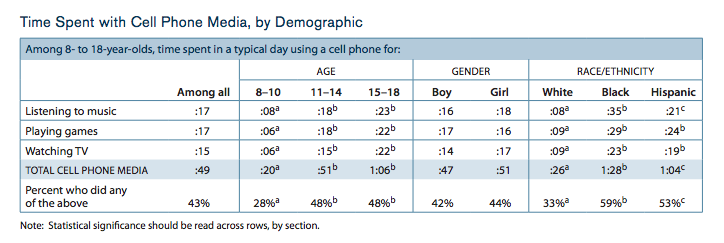
In the many links below the archived video of Watkins’ session on connectedlearning.tv is a link to the Kaiser Family Foundation’s Generation M2 study. As I read through that one, I found it curious that the study only categorized time spent with cell phone media three ways: listening to music, playing games, and watching TV. (Here’s the chart.)#

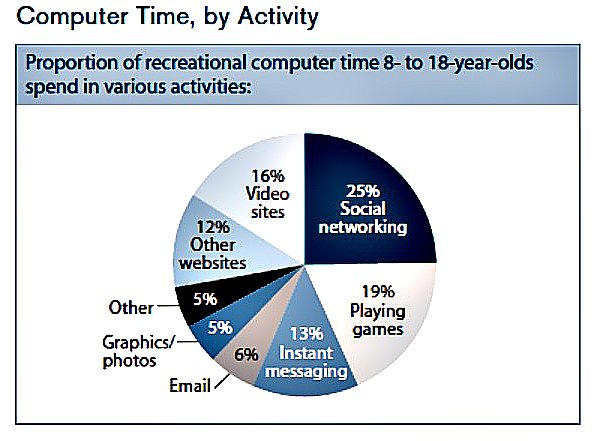
On the other hand, the study categorized computer use in eight ways. (Here’s that chart.)


This raised a few questions for me. First, why paint such a limiting picture of mobile media use on cell phones when these devices support all of the practices attributed to computer time? Just by approaching the different devices this way, the report suggests a disparity of media practices that may not exist.

I also wondered, looking at this pie chart, how can researchers make the distinction between “social networking” and these other media practices, many of which take also take place on social networks. YouTube probably qualifies as a video site, but it also is a social network. On Facebook- the social network- users play games, instant message one another, and create, edit and share photos and videos. “Social networking” is such a general verb, that it really only identifies the platform on which teens might interact with peers and media.

Especially as teachers endeavor to explore interest-driven practices of youth with digital tools, we can continually refine how we examine those practices.

Resources: 
"Digital Differences." Pew Research Center's Internet & American Life Project. Web. 03 June 2012. <http://pewinternet.org/Reports/2012/Digital-differences/Overview.aspx>.

"Report: Generation M2: Media in the Lives of 8- to 18-Year-Olds - Kaiser Family Foundation." Kaiser Family Foundation. Web. 03 June 2012. .

Thursday, May 10, 2012

3 Challenges for a game design school


I’ll be blogging in response to a webinar series offered by connectedlearning.tv at the invitation of the National Writing Project’s Digital Is.


Maybe the most inspiring thing about listening to Antero Garcia, a young teacher who has pushed on the boundaries of pedagogy in a very difficult teaching environment, is that words like “problem” and “challenge” seem to have only the best connotations when he says them.  In this week’s connectedlearning.tv webinar, Garcia detailed some projects he has lead in his high school English class in south central Los Angeles. He shared his thinking about technology in schools and participatory learning. He also described a detailed game his students played which they later opened up to the larger community. After he did all of this, he asked a question:

He asked the connected learning community, "How do we do this with teachers who aren't necessarily oriented toward (game design) practices?" Garcia explained that he’s helping plan a new public high school in South Central Los Angeles, the Critical Design and Gaming School. His concern is that the school will be staffed with veteran teachers who might not have any interest in the type of pedagogy the new school hopes to employ.

As fascinated as I was by the air quality problem he posed to his English class, this problem- starting a school- strikes me as infinitely more interesting and exciting- not to mention difficult- than solving air quality problems in LA.  

Here are three ways I would frame the challenges he faces: 

1 H
ow can you incorporate game design into professional learning, instructional planning and community development so teachers begin to connect game design with tangible learning? For teachers who have never attended schools built on game principles, applying game theory to teaching will be very hard, especially if they have not learned a great deal in their lives from playing games. Since opening a new school will be a huge learning experience for every staff member involved (just ask someone who has opened a school), this is an opportunity to put your pedagogy to the test with adults.

What are some ways you can temper your commitment to the project- and to change- with a gentle voice and and a welcoming ear that honors the experiences of veteran teachers? In his book Instructional Coaching: A partnership approach to improving instruction, Jim Knight compares the delicate task of asking teachers to change with going over to your sister’s house and asking her to change her parenting. Your new school will symbolize in many ways the idea that teaching practices ought to change. This will sound like a criticism to many. How can you keep those folks involved?

Can you solicit dissent to better inform your overall design? Since you endeavor to rethink pedagogy and reform education, you need everyone’s best thinking, not just the small group of technophiles, or the passionate gamers who may teach in your school. How can you keep critical thinking at the forefront of your work with staff?

Saturday, April 7, 2012

An elephant of a sandbox #change11

I’ll be blogging in response to a webinar series offered by connectedlearning.tv at the invitation of the National Writing Project’s Digital Is.


In last week’s webinar, Philipp Schmidt, Co-Founder and Executive Director of Peer2Peer University (P2PU), spoke with host Howard Rheingold and a small panel of doctoral students who study connected learning.

P2PU, a grassroots online open education project, strives to provide high-quality, low-cost educational opportunities. Currently, P2PU offers a myriad of free, online courses.

Schmidt offered three questions to begin the discussion about scaling online learning:


How do you scale online courses that don’t stink?


What are new ways to recognize achievements?


How do you assess 21st century skills?


Now, days after the webinar, having viewed the archived session and consider these questions, I have the found the answers and they are ready for publication in this blog.

The correct answer to all these questions is: YES! (Any lower-case response, or response not in bold should receive only partial credit.)

My confidence in this answer comes from hearing Rheingold say to Schmidt about learning online, “It is still early.” 

It is worth noting that someone of Rheingold’s long experience hesitated to draw conclusions about online education. At this stage great questions serve to guide thoughtful inquiry.

The interchange made me remember the tale of the blind men and the elephant. In the old Indian tale, each man touches only a small part of the elephant, and therefore describes the elephant as something consistent with the part he can feel.

Having completed my second P2PU course in their school of education, I can look back at my experiences in those courses and talk about the excellent facilitation and the community building I experienced in the courses online sessions. To me, that is online learning.

Having participated in a couple of Massive Open Online Courses (MOOCs), I can point to those experiences, all exploratory and positive, and say “that is online learning.”

But it is early. So, I remember the blind men and the elephant. In my passionate interest to explore and discuss online learning, I may just have a hold of this elephant’s tail.

Still, from my vantage point here at the tail, I  found myself disagreeing with the doctoral students in the discussion when I watched the archived web session. One of the participants made the claim that unless the courses offered certificates that academic institutions or employers recognize, time spent in open courses is akin to time spent watching soap operas. This is certainly not the case from my side of the elephant. The doctoral students in the webinar have their own position on this elephant of open online learning. Whatever appendage of the beast they have their hands on, the student researchers in the discussion seemed to think that certification is the most important thing in online learning. I feel confident that many of my “classmates” in the #change11 MOOC and my most recent P2PU course would disagree.

Maybe these doctoral students, working to complete their own certification requirements in varying education contexts, have a view of the world right now that says learning is pursuit of certification.

In the web session, Schmidt acknowledged the importance of thinking about learners and their motivations and pushed back on the notion that open learning must yield tangible rewards, saying, “It is great to be a sharer.”

Here are some other questions Schmidt posed for the group’s consideration:

What are good pathways from interest to learning?

What support mechanisms are needed?

What is the role of content?


The challenge for educators exploring online learning is to answer these questions by asking question. When I begin to draw conclusions, I will remember that it is still early. Again, a correct answer to these questions is “YES!”

The great invitation of online learning, especially in open virtual spaces like P2PU, filled with discussions, challenges and communities, is that the whole thing feels less like the elephant of traditional education and more like a sandbox. Educators can take their questions about online learning into the Schmidt’s sandbox where, through play and exploration, they might arrive at some answers. Or maybe better questions.

Friday, March 30, 2012

Reconceptualizing the library #change11

I’ll be blogging in response to a webinar series offered by connectedlearning.tv at the invitation of the National Writing Project’s Digital Is. In this week's session, hosted again by Howard Rheingold, we heard from Buffy J. Hamilton, The Unquiet Librarian, who engaged in a discussion about libraries and learning spaces.


Dr. David Preston’s high school class “hung out” during the connectedlearning.tv webinar and asked a big question: "What [does] the future of libraries look like, considering the rapid growth of reading technologies such as the Kindle and the iPad?"

A great question by itself, this inquiry only gets better when you consider the context: from their classroom in California, this group of students asked this question of Buffy Hamilton an innovative librarian in Georgia, Howard Rheingold, prolific author and a teacher at Stanford, and a live stream audience of educators. It appears these students came to the right place for answers.

In her opening remarks, Hamilton hinted at the work that educators will have to do to answer the students’ question. She challenged her audience to “reconceptualize the library as a place that is a shared composition.” She said educators have to collaborate with the students they serve to “compose and construct the story of library participation,” with the goal of developing responsible, agentive students who learn what education can be in a lot of different spaces.

Where do we even begin?

Well, we might begin here- Librarian 2.0. It’s Rheingold’s 2010 interview of Hamilton. When I read this the day after the web session, still thinking about connected learning, I stopped only for a brief moment to name what I was doing.

I’m looking at exemplary student work that came from an nationally-recognized librarian’s collaboration with a classroom teacher, mediated by the writing of an expert on the Internet and learning. (And I’m in my pajamas!)

I poured through some student projects, and I read for a while on each of the two blogs I found that Hamilton offers, The Unquiet Library, The Unquiet Librarian. (I found three or four other virtual platforms for the work she does with her school, and skimmed those, too.)

I think I got a glimpse of the future of libraries, which is what those students in the web session asked about. I saw pictures of a dynamic physical space and I toured an unbounded virtual space.

During the connectedlearning.tv web session, Hamilton spoke about her work with students and Personal Learning Environments (PLEs), remarking that asking students to work in public, virtual spaces was asking them to take a “leap of faith.” Hamilton’s own work demonstrates for students and teachers alike the benefits of this leap. By publishing her work to the web, she gives us all access to her joyful approach and her strong thinking about physical and virtual spaces which promote inspired learning. By sharing in this way, she encourages other educators to take the leap of faith, to share and think with a larger community focused on answering tough questions.

Saturday, March 24, 2012

Watch the geeks

I’ll be blogging in response to a webinar series offered by connectedlearning.tv at the invitation of the National Writing Project’s Digital Is. I highly recommend the archived session hosted by Howard Rheingold in which Mimi Ito lead a discussion about connecting interests and achievement with a panel of librarians, teachers and parents.


Mimi Ito studies geeks.

It takes one to know one!

The geeks, she reports, are highly interest-driven and immersed in technology. Ito says geeks use different media platforms than other students because they put their interests first and friendships, while important, come second. To me, that means they might prefer figment.com to Facebook, for example.

I share Ito’s interest in geeks and I like to conduct my own informal studies on them.

It used to be easier to spot geeks. They were the ones wearing glasses, reading books. They were the only ones who knew how to use a computer, before using a computer became so social. Now everyone’s on some kind of a computer and you have to really look closely to see which kids are pursuing their interests. It is harder to know who is hanging out, who’s messing around and who’s geeking out. Before, you could stake out a library and find the geeks. Today, even if you go to the library, you’ll see a bunch of kids on computers. You have to sneak up behind them to figure out who the geeks are.

I like to sneak up behind the geeks because I’m a teacher and I have a sneaking suspicion that studying the geeks a little more closely will suggest possibilities for a way forward in education, especially in an era of increased accountability and emphasis on measuring educational outcomes. Schools can no longer take geeks for granted. We really ought to poke and prod them, prick them with pins, find out how they tick.

When I find a real geeky geek, about 11 or 12 years of age, and I poke him real hard, he gives up his secrets! “School is easy, when it isn’t too boring,” he wails. “Some classes are fun, when we get to do cool stuff, or when we read, write and talk about cool stuff.”

Geeks might not like homework, but if I prick them with a pin, they’ll tell me their ten favorite homework assignments. I record the answers in my notes because I think it will help us find a way forward in education.

Here’s a thing I’ve noticed: when you leave a geek to his own devices, he makes up his own homework, and he enters into his own intellectual discussions. Geeks use the Internet for this all the time. You basically cannot click twice on the web without encountering a geek collaborating with other geeks.

Geeks interests change all the time, but we can learn a great deal by studying how they pursue those interests.

To help in this effort, I’m growing my own geeks.  

The biggest one is six and her interests are as follows: dinosaurs, roly polys, dogs, singing, and animals.

Her mother won’t let me prick her with a pin, so I have hang out with my little geek and make careful notes about her interests. I recently took her to the local library. She’s learning to read, so it is an opportune time to watch this geek blossom.* I watch how she walks through the bookstacks, introduces herself to other kids and explores. It doesn’t get interesting until I start picking out the books.

I’m an English teacher, so I have an agenda.  My approach is complex- I look for books on her instructional level, but I also want high quality literature. I look for author’s names: De Paolo, Fox, Carle, Pollaco, and Yolen. Pulling books from the shelves, I look at the sentence structure, the patterns and the ratio of text to picture support. I find the perfect books for this reader's development and then things get interesting.

"No, Dad. I only want dinosaur books."

Despite my  assurances that she will love the books I have chosen, the little geek, unyielding, insists on a new search strategy for me, the reading "expert." Not only do I have to reshelve the instructionally appropriate materials, I have to find dinosaur books. Not real dinosaur books, I’m told, but dinosaur books where dinosaurs talk and play. We find about 10 and when the little geek concedes that dragon books will work, too, we check out 13 in total.

I record my observations.

Our oldest geek rejects expert-selected, instructionally appropriate materials in her zone of proximal development. She demands to focus on a topic and style of text. In the weeks following our trip to the library, she independently increases her time on text with the self-selected materials. Her method of reading practice, while different than the work I might have prescribed, increases instructional opportunities to model and mentor reading strategies.  


During her recent discussion on connectedlearning.tv, Ito asked a small panel of parents and educators an important question, “Have you seen in your own work some potential for interest-driven work with students?”
So, I believe Mimi Ito is onto something when she asks about the potential for interest-driven instruction. I also believe we can ask educators another question: Have you seen in your work the negative potential of continuing with a course of instruction that did not interest students?


*During the writing of this blog post, my oldest geek walked by and told me, “Don’t forget your periods at the end of your sentences, Dad!”