Showing posts with label #change11. Show all posts

Saturday, February 13, 2016

Why I'm signing up for Personal Learning MOOC

I registered this morning for Stephen Downes' Personal Learning MOOC. As I completed the registration form I was prompted to explain why I was interested in LPSS, a platform we'll use in this course. Here's the answer I put in the text box:
My interest in this platform ties to my interest in participating in Stephen Downes' Personal Learning MOOC. I've participated in cMOOCs like Change11 and ETMOOC and I helped create and facilitate the National Writing Project's CLMOOC. The concept of personal learning is fascinating to me. I currently work as an ed tech coordinator for a large urban school district. For us, the words personalized learning are becoming buzz words with fuzzy meanings skewed by ed tech vendors. My basic familiarity with Downes' work and the workings of cMOOCs tells me that this course will push my thinking and help me connect with the current thinking about personal learning. 

Sunday, June 3, 2012

Access and activity


I’ll be blogging in response to a webinar series
offered by connectedlearning.tv at the invitation of the National Writing Project’s Digital Is.


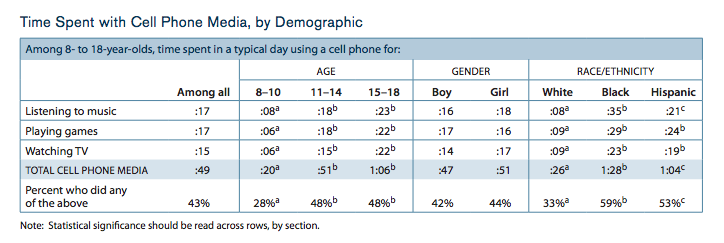
During S. Craig Watkins’ connectedlearning.tv session, he explained that Black and Hispanic teens spent more time on mobile devices than White teens. Watkins, a principal investigator of the Connected Learning Research Network and a teacher at the University of Texas, called this a “mobile paradox,” a seeming contradiction to the digital divide. Though they are more likely to live in homes without broadband access, Black and Hispanic teens are bridging the access gap using mobile devices.

A recent  Pew Internet study reports the same:
Among smartphone owners, young adults, minorities, those with no college experience, and those with lower household income levels are more likely than other groups to say that their phone is their main source of internet access.

In the many links below the archived video of Watkins’ session on connectedlearning.tv is a link to the Kaiser Family Foundation’s Generation M2 study. As I read through that one, I found it curious that the study only categorized time spent with cell phone media three ways: listening to music, playing games, and watching TV. (Here’s the chart.)#

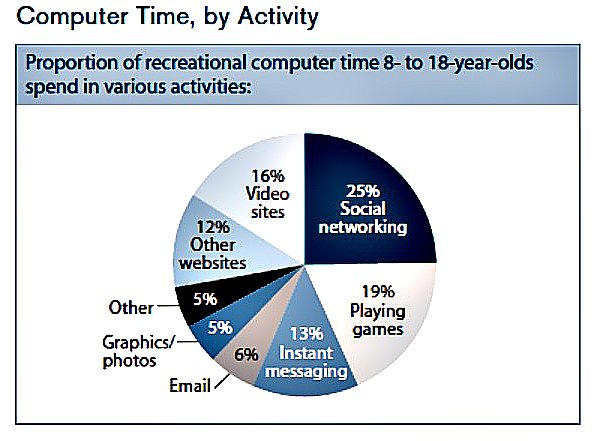
On the other hand, the study categorized computer use in eight ways. (Here’s that chart.)


This raised a few questions for me. First, why paint such a limiting picture of mobile media use on cell phones when these devices support all of the practices attributed to computer time? Just by approaching the different devices this way, the report suggests a disparity of media practices that may not exist.

I also wondered, looking at this pie chart, how can researchers make the distinction between “social networking” and these other media practices, many of which take also take place on social networks. YouTube probably qualifies as a video site, but it also is a social network. On Facebook- the social network- users play games, instant message one another, and create, edit and share photos and videos. “Social networking” is such a general verb, that it really only identifies the platform on which teens might interact with peers and media.

Especially as teachers endeavor to explore interest-driven practices of youth with digital tools, we can continually refine how we examine those practices.

Resources: 
"Digital Differences." Pew Research Center's Internet & American Life Project. Web. 03 June 2012. <http://pewinternet.org/Reports/2012/Digital-differences/Overview.aspx>.

"Report: Generation M2: Media in the Lives of 8- to 18-Year-Olds - Kaiser Family Foundation." Kaiser Family Foundation. Web. 03 June 2012. .

Saturday, April 28, 2012

Game design and rethinking failure in school #change11


I’ll be blogging in response to a webinar series offered by connectedlearning.tv at the invitation of the National Writing Project’s Digital Is.


Katie Salen, executive director of the Institute of Play, offered principles for instructional designers to use in order apply the theories of game design in schools in this web session on connectedlearning.tv. Though the session title indicated there were six principles, I got four:

1. Create a need to know

2. Create a space of possibility

3. Create opportunities for authority and expertise to be shared and reciprocal.

4. Multiple, overlapping paths to mastery.

From failure to iteration and prototype

In her explanation and exploration of the fourth point, she made the observation that game designers have to construct games in a way that participants can find success. A game designer has executed a poor design if players cannot find success. This is a distinct contrast from traditional classroom settings, she noted, where the instructional design suggests that not all student will find success and when students do not, schools blame the students more than they rethink design.

Participants in the web session asked Salen how schools built on game design help students with the routine failure that players experience to learn in game settings. She explained that gamer view failure differently. In the schools she works with- one in Chicago and one in New York- educators intentionally talk about failed efforts as iterations, prototypes and proof that approaches do not work. The hope is that students see success as possible. They, like players in a game, learn that risk and experimentation pay off. When students try and do not succeed in game design schools, they can trust that there is a pathway to success and that they are in the process of finding it.

My own failure

During the recorded web session, I paused the discussion to do a little research when I heard a mention of the game Minecraft. Having read recently about classroom implications for games like Gamestar Mechanic and Little Big Planet, I wanted to familiarize myself with Minecraft, a title I’m encountering more and more in my online reading about games in education.

In minutes, I downloaded a free app for the pocket edition on my smartphone. In no time, my little avatar was running over the block landscape and stopping to stack blocks. I had to build a structure that would protect me after nightfall. Entirely too soon, night did fall and hordes of monsters came out of nowhere and destroyed me.

With my short experience with Minecraft, the pocket edition, I gained a new appreciation for the term my students use more and more: “Epic fail.” My epic failure may have hooked me on the game, though. Failure gave me a few objectives for my next experience, too. I know now that I will probably have to explore the terrain more, and figure out how to stack these blocks where I want them to go. Once I learn how to navigate and build, I will need to figure out what kind of structure will impede the murderous monsters. I’m probably going to fail, like, 10 more times before I develop the competency to advance in this game. Luckily, this is a game, though, so the learning is probably going to be fun.

Tuesday, April 17, 2012

Touring a virtual classroom #change11


I’ll be blogging in response to a webinar series offered by connectedlearning.tv at the invitation of the National Writing Project’s Digital Is.


Last night I had an interesting, 21st Century choice to make: read my newest e-book, Net Smart, by Howard Rheingold, or watch Rheingold’s webinar on connectedlearning.tv.

I stopped and thought about how I wanted to learn about technology and education.

As a lifelong bookworm, I have always enjoyed the reading I choose outside of school over assigned reading at an assigned pace. The choice I make to hoard books and binge on texts is constructive personal foible that leaves me in a house with an overflowing bookshelf or book basket in every room. When I choose to grab a book and settle in, I make a familiar choice.

Increasingly, I have a new, less familiar option. With the time that I used to devote to personal reading, I can choose to join, observe or facilitate online learning conversations, reminiscent of class discussions. And I do. More and more, I log in to webinars and find myself using a different implement to scratch a personal learning itch.

So, I might have settled in with a good book and read Rheingold’s latest. Instead, I watched a webinar recording and found the author, the regular host of these sessions, in the role of the subject, talking with a panel of educators, with Mimi Ito facilitating the conversation. He shared the work he is doing in his Social Media Classroom, explaining the way he facilitates cooperative learning.

Watching from the comfort of my workstation at home, I toured his virtual classroom, detailing how these learners collaboratively construct mind maps during their online sessions, sometimes refining these maps individually after the session. Each part of the virtual space has a thoughtful, experimental purpose. The group uses a wiki to define terms and develop a common language. Discussion forums house the questions the group values, while blogs are spaces of personal reflection for the learners, and all the spaces invite participation. In this virtual space, Rheingold experiments online with cooperation and learning. He calls it “peeragogy.”

Watching Rheingold’s tour of his virtual classroom and hearing his discussion with the panel, I was reminded of the 21st Century choices I have when I leave the comforts of my personal space and go to work in schools. I get to decide about how to approach learning with colleagues and students. I, too, might engage with learners in some of the ways he modelled. My colleagues and I might construct our own mind maps, engage in asynchronous discussions and publish our reflective writing online for a larger, global audience.

As these 21st Century choices start to add up, I think about another affirming choice I have: How will I frame my own experiments in rapidly-evolving contexts like the Internet? (And school.)

Saturday, April 7, 2012

An elephant of a sandbox #change11

I’ll be blogging in response to a webinar series offered by connectedlearning.tv at the invitation of the National Writing Project’s Digital Is.


In last week’s webinar, Philipp Schmidt, Co-Founder and Executive Director of Peer2Peer University (P2PU), spoke with host Howard Rheingold and a small panel of doctoral students who study connected learning.

P2PU, a grassroots online open education project, strives to provide high-quality, low-cost educational opportunities. Currently, P2PU offers a myriad of free, online courses.

Schmidt offered three questions to begin the discussion about scaling online learning:


How do you scale online courses that don’t stink?


What are new ways to recognize achievements?


How do you assess 21st century skills?


Now, days after the webinar, having viewed the archived session and consider these questions, I have the found the answers and they are ready for publication in this blog.

The correct answer to all these questions is: YES! (Any lower-case response, or response not in bold should receive only partial credit.)

My confidence in this answer comes from hearing Rheingold say to Schmidt about learning online, “It is still early.” 

It is worth noting that someone of Rheingold’s long experience hesitated to draw conclusions about online education. At this stage great questions serve to guide thoughtful inquiry.

The interchange made me remember the tale of the blind men and the elephant. In the old Indian tale, each man touches only a small part of the elephant, and therefore describes the elephant as something consistent with the part he can feel.

Having completed my second P2PU course in their school of education, I can look back at my experiences in those courses and talk about the excellent facilitation and the community building I experienced in the courses online sessions. To me, that is online learning.

Having participated in a couple of Massive Open Online Courses (MOOCs), I can point to those experiences, all exploratory and positive, and say “that is online learning.”

But it is early. So, I remember the blind men and the elephant. In my passionate interest to explore and discuss online learning, I may just have a hold of this elephant’s tail.

Still, from my vantage point here at the tail, I  found myself disagreeing with the doctoral students in the discussion when I watched the archived web session. One of the participants made the claim that unless the courses offered certificates that academic institutions or employers recognize, time spent in open courses is akin to time spent watching soap operas. This is certainly not the case from my side of the elephant. The doctoral students in the webinar have their own position on this elephant of open online learning. Whatever appendage of the beast they have their hands on, the student researchers in the discussion seemed to think that certification is the most important thing in online learning. I feel confident that many of my “classmates” in the #change11 MOOC and my most recent P2PU course would disagree.

Maybe these doctoral students, working to complete their own certification requirements in varying education contexts, have a view of the world right now that says learning is pursuit of certification.

In the web session, Schmidt acknowledged the importance of thinking about learners and their motivations and pushed back on the notion that open learning must yield tangible rewards, saying, “It is great to be a sharer.”

Here are some other questions Schmidt posed for the group’s consideration:

What are good pathways from interest to learning?

What support mechanisms are needed?

What is the role of content?


The challenge for educators exploring online learning is to answer these questions by asking question. When I begin to draw conclusions, I will remember that it is still early. Again, a correct answer to these questions is “YES!”

The great invitation of online learning, especially in open virtual spaces like P2PU, filled with discussions, challenges and communities, is that the whole thing feels less like the elephant of traditional education and more like a sandbox. Educators can take their questions about online learning into the Schmidt’s sandbox where, through play and exploration, they might arrive at some answers. Or maybe better questions.

Friday, March 30, 2012

Reconceptualizing the library #change11

I’ll be blogging in response to a webinar series offered by connectedlearning.tv at the invitation of the National Writing Project’s Digital Is. In this week's session, hosted again by Howard Rheingold, we heard from Buffy J. Hamilton, The Unquiet Librarian, who engaged in a discussion about libraries and learning spaces.


Dr. David Preston’s high school class “hung out” during the connectedlearning.tv webinar and asked a big question: "What [does] the future of libraries look like, considering the rapid growth of reading technologies such as the Kindle and the iPad?"

A great question by itself, this inquiry only gets better when you consider the context: from their classroom in California, this group of students asked this question of Buffy Hamilton an innovative librarian in Georgia, Howard Rheingold, prolific author and a teacher at Stanford, and a live stream audience of educators. It appears these students came to the right place for answers.

In her opening remarks, Hamilton hinted at the work that educators will have to do to answer the students’ question. She challenged her audience to “reconceptualize the library as a place that is a shared composition.” She said educators have to collaborate with the students they serve to “compose and construct the story of library participation,” with the goal of developing responsible, agentive students who learn what education can be in a lot of different spaces.

Where do we even begin?

Well, we might begin here- Librarian 2.0. It’s Rheingold’s 2010 interview of Hamilton. When I read this the day after the web session, still thinking about connected learning, I stopped only for a brief moment to name what I was doing.

I’m looking at exemplary student work that came from an nationally-recognized librarian’s collaboration with a classroom teacher, mediated by the writing of an expert on the Internet and learning. (And I’m in my pajamas!)

I poured through some student projects, and I read for a while on each of the two blogs I found that Hamilton offers, The Unquiet Library, The Unquiet Librarian. (I found three or four other virtual platforms for the work she does with her school, and skimmed those, too.)

I think I got a glimpse of the future of libraries, which is what those students in the web session asked about. I saw pictures of a dynamic physical space and I toured an unbounded virtual space.

During the connectedlearning.tv web session, Hamilton spoke about her work with students and Personal Learning Environments (PLEs), remarking that asking students to work in public, virtual spaces was asking them to take a “leap of faith.” Hamilton’s own work demonstrates for students and teachers alike the benefits of this leap. By publishing her work to the web, she gives us all access to her joyful approach and her strong thinking about physical and virtual spaces which promote inspired learning. By sharing in this way, she encourages other educators to take the leap of faith, to share and think with a larger community focused on answering tough questions.

Wednesday, March 28, 2012

What am I doing in this MOOC? #change11

I read Stephen Downes’ address at EdgeX2012, highlighting the parts that were meaningful to me. Here is the annotated link in Diigo that shares my highlights. They might be useful to you if you’re pressed for time and find yourself wanting to skim the long post. I affixed to the digital text a virtual sticky note which reads, “When online begins to outperform face to face.”

After reading Downes’ address, I thought about his assertion that MOOCs aren’t about content, they are about doing. Here are some of the things I’ve done in this MOOC to date:

Annotated and shared those annotations

(See above.)

Blogged

I wrote informally about the speakers, the content and the experience of this MOOC.  

Commented

At one point during my participation in this course, I made my own rule that if someone commented on my blog, I would comment on theirs. Interesting stuff, this rule-making in an open online context. I would also like to do a better job of following those who comment on my writing and I try to “pay it forward,” reading the latest blogs to help myself feel current, but also to encourage recent participants.

Chatted

In the backchannels of the web sessions, I chat frequently and furiously, at times losing track of the speaker’s presentation. I’m fascinated by backchannels, their role in the session and the tangents and trails they take. I like to catch up on sessions I miss in the recording, taking notes online to record my thoughts and support my reflection, but without the live backchannel, the recordings are not nearly as engaging.

Questioned

I pose questions in chats during online sessions, and I pose them in the comment fields below participant blogs. My questions also leak into my own blog posts.

Challenged

In a previous blog post, I shared a workshop activity which invited readers to add their ideas to a Prezi I created. I was delighted to see a few additions from other participants.  


Moonlighted

Recently, during the “lull” in this MOOC, I co-facilitated a three-week open course through P2PU.org. Interestingly, in our discussion threads for that course I connected with (at least) three other participants from this MOOC.

When I think about the connections formed in a MOOC, I think about the common experiences of participants who have navigated, consumed, published, lurked and Tweeted as part of their participation in #change11. What changes? Our work? Our expectations? Our skill learning online?

Saturday, March 3, 2012

Technology for community sake #Change11


Right before I show YouTube videos by Michael Wesch in professional development workshops, I always take a quick poll of the audience, asking who has heard of the Kansas State professor. In the last four weeks, I have had the opportunity to lead three variations of the same professional development workshop, with audiences ranging in size from 13 to 35. I average about one raised hand each time I ask. This comes as both good and bad news; good because I can keep showing the videos and asking participants, most of whom are inspired by 4 minutes of hearing Wesch speak, about the implications of his work for K-12 public education; bad because it indicates to me that K-12 educators, confronted by the same issues of scale and relevance that Wesch tries to optimize in his courses at Kansas State, have not heard of his cutting-edge work.


In this video, A Vision of Students Today, Wesch’s students famously publish the statistical results of a class survey they did on a Google Doc. In other talks Wesch has done, among them this address to the University of Manitoba in 2008, he details how he uses web portals to aggregate class resources and student work.  

The tech integration in these videos in not about portals, wikis and RSS feeds. I see Wesch gathering student data in new ways, employing a strategy not unlike a very low-tech system like “Fist to Five Feedback,” where the teacher asks students to quickly assess the success of her lesson.

When I read a recent article in the Chronicle of Higher Education by Jeffrey Young, I realized that the importance of Wesch’s could elude the higher ed community. The article dismisses Wesch’s use of technology as a strategy that other professors are unable to apply, and then concludes that he is just talented, so his methods don’t matter. A talented lecturer might be just as effective using less interactive methods, according to Young.

Participants in technology workshops I lead readily agree that the purpose behind integration matters more than the tools. This is especially true in Wesch’s case. When a colleague of his remarks that they tried his methods and had them result in “chaos,” I worry that institutions cannot see past tools to instructional purposes. 


My biggest worry is that we might watch powerful practices enhanced by technology and see only the technology. We might not notice that Wesch asked his students, his paying customers, what it is like to be a student in his class and then used technology to maximize their experiences as learners.We might forget that when his students report that their professors don’t know their names, he uses technology to create social connections for them in a class of 200. We have to see past his web platform to think critically about his purpose.

When technology gives us the ability to hear from all students all the time, what questions will we ask them? Wesch asks his students about relevance and significance. If we don’t know what questions to ask, it doesn’t matter how well the technology helps us aggregate the answers.

Sunday, February 26, 2012

Thinking collaboratively and creatively about digital texts and tools... #change11

Author: Samantha Penney, samantha.penney@gmail.com 
I recently read a Twitter feed discussion between educators about this graphic, which was published on the University of Southern Indiana's website. They were critical of this arrangement of tech tools, calling it "arbitrary foolishness" and generally "disappointing." I tended to agree, but the discussion brought me back to an article I read recently by Alice S. Horning, "The Psycholinguistics of Literacy in the Flat World," where she claims that our use of language is evolving, especially in digital environments and that texts themselves are going through an evolutionary process.

Her article reminded me of working with some high school seniors who were creating a Prezi on the evolution of video games to accompany a larger paper they'd written. They used an image showing an evolutionary chain of famous video game characters as an inspiration to draw their chain. So I wonder about the potential for evolutionary chains as an organizing structure to think about digital texts and tools. I generated a Prezi to capture my thinking, and also as a place where participants in a professional development workshop might explore these ideas together. Alas, due to tech issues with Internet access at the conference where I was presenting on education and technology, this Prezi went largely unused.

Reading Geetha Narayanan's introduction on the MOOC today with her commentary about the lack of emphasis on creativity on the web, I want to invite MOOC participants to engage in a discussion of texts and tools in this (potentially) creative space, if only because I'm guaranteed that MOOC participants will have Internet access, something we can't say about an ed tech conference in 2012. Check out the Prezi below. The link you need to edit is in the Prezi.

Friday, February 10, 2012

Learner, not lurker... #change11


I’m still captivated by apologies on the MOOC. Lately, I notice blog entries where participants label themselves “lurkers.” While I understand the term as it relates to Internet culture and discussion boards, I read it as a form of apology or a caveat to informal, infrequent participation in this course which so often doesn’t feel like a course.

For my own part, my work in open courses ebbs and flows. At times I am a virtual version of the student who sits up front and raises his hand a little too much. Other times, I’m the person who asked to survey a popular course, only to show up late, unfamiliar with the material being discussed. These analogies come from traditional education because that is how I understand my participation in any course.

As a learner unbundling content relevant to me I have to make sense of how I am learning, what I am learning and how reading and writing fit in my daily life. In order to completely understand how I am learning from a MOOC, I have to also set aside my traditional schooling and consider other challenging and rewarding- informal- learning experiences. I have to think about how I learn to parent.  

Coming back to this MOOC, despite my late arrival and my occasional “lurker” status, the course will impact my work. I will read Howard Rheingold’s new book and think about the implications for reading instruction in public schools. I will think about how attention probes might inform some burgeoning reading intervention ideas like Internet reciprocal teaching.

I want to set aside the term “lurker” for myself and think about participation in an open course as something that ebbs and flows with my life. I prefer “learner.” I also want to revisit every apology I have had to make for falling behind in a course I paid handsomely for that didn’t meet my needs.

Monday, January 30, 2012

Social media spaces and learning potential...#change11


    At the invitation of my district’s educational technology department, I recently presented to a group of instructional leaders about the use of social media in education. Specifically, my topic was Twitter. In planning the session, I decided to avoid the discussion of how students might use Twitter in the classroom, opting instead to excerpt a couple of paragraphs from Personal Learning Networks, by Will Richardson and Rob Mancabelli, before presenting a quick YouTube video* and linking to some relevant hashtags and users.
(I used this page on my wiki and asked for participants to reflect on a Google Doc one day and an Edmodo discussion thread another day.)
    The session was a success in that it generated a big buzz among the participants, most of whom opted to create Twitter accounts although I had not required, recommended or facilitated their doing so. Principals giggled, listing and followed each other. My old boss asked why her profile picture was an egg. When I explained the relationship between Twitter's bird logo and her default profile pic, she delighted site's nifty metaphor about comparing new users with unhatched chicks.
    Since the participants grappled with the safety concerns of student use during earlier presentations on YouTube and Facebook, I closed with the first minute and a half of Will Richardson’s TED talk and made the comment, “ In the interest of full disclosure, I could have just as easily guided you through Twitter content that would have generated a strong anti-Twitter sentiment. I thought for our purposes today it was more important to show how it might be used in professional development and why a high school teacher might argue for allowing students to use Twitter for research.” I wanted to finish in a way that might both honor and push back against their critical thinking about social media tools in the classroom.
    Afterward, I returned to an analogy I’ve been kicking around: Saying that schools should not use social media tools in the classroom by citing the potential dangers is like schools citing crime statistics and refusing to do community-oriented projects in the city of Chicago. Facebook is a huge virtual space that users explore largely without tour guides. As we consider the use of virtual spaces, especially gigantic virtual spaces like Facebook and Twitter, how can we map those spaces and identify the learning spaces within with the best potential?


* In an interesting connection to Howard Rheingold’s discussion of attention and his directing participants to the selective attention test, I noticed only on the third or fourth viewing of my screencast video that one of the trending hashtags on Twitter during my recording was "#mustybutthole," which went completely unnoticed even among my co-facilitators who sat through my session twice in three days. A sadistic part of me wanted to point it out afterwards** as an example of selective attention.


**Aside from my sadistic impulse, I would direct educators’ to the inappropriate hashtag in order to point out that Twitter, like most any public space that educators might explore for possibilities, will have evidence of public use that educators might categorize as misuse.

Saturday, January 7, 2012

Talking while the teacher is talking: learning in the back channel of #change 11


I’ve experimented with back channels in my 7th grade language arts classroom. On occasion, I used it as a way to focus students’ attention during Socratic circles. The outer circle of students, three times larger than the inner, armed with netbooks, had to respond on a wiki page discussion thread to the participants’ comment during the discussion. The outer circle recorded questions, reactions and quotations from the one participant they tracked. Since I was working with adolescents, the silent social opportunity during the Socratic circle kept everyone active and engaged, which can be a challenge when the outer circle has to sit quietly and record on tally sheets or some other paper record to track the conversation.

So, I believe in the potential of back channels and was excited to participate in the chat room during both of Howard Rheingold’s live sessions for the MOOC this week. From past experiences in Blackboard Collaborate, I’ve grown accustomed to the webinar format and I bounced my attention from the chat thread to the video feed of Rheingold’s presentation. It was interesting to participate this way. He taught us that there is no such thing as multi-tasking, just task switching. According to Rheingold, we pay attention costs with each switch.

With that learning in mind, I reflected on my participation. Between the two sessions I felt at times engaged, rewarded and distracted by the chat.

I wonder: What are the implications for teaching and learning in back channels, when participants effectively talk while the teacher is talking?

I’m thinking of ways participants might revisit the back channel transcript to support ongoing thoughtful participation and so that we might better understand the potential. Here are three possibilities I see for using the back channel transcript:

1. Have participants search through a transcript of the back channel and code their responses based on how they feel their participation impacted their attention to the session or their learning.

2. Ask participants to connect the small, quick discussions with other discussions online. For example, search for discussion forums and comment threads elsewhere online where participants might extend their conversations. (A quick teacher discussion in a chat room might easily connect to some of the larger group discussion threads on edutopia.org, for example.)


3. Ask each participant to identify the most important post in the back channel and blog about that immediately afterward.

Please add any suggestions you might have in the comments.