I've been playing and reading about PokemonGo for about a day and a half now and almost as soon as I gave Professor Willow permission to pretty much steal my identify by giving the app access to my camera, location and contacts, I started thinking about how this immersive game might mediate Connected Learning. Since its release just last week, the game has become a mini social phenomenon, draining cell phone batteries and inspiring memes, and the social media response has been every bit as immersive as the game. An article that has enjoyed some heavy circulation on Twitter was one of the first to comment on the game's educational potential. "14 Reasons PokemonGO is the Future of Learning" by David Theriault missed the mark by engaging in all-too-familiar educational technology hyperbole. I put some mild criticism in the margins (here and here) via the social annotation tool hypothes.is. My commentary was quickly met in those margins by the thoughts of other educators interested in games and digital tools.
Screenshot of the annotated version of Theriault's article.
In what amounted to a short annotation flash mob, Theriault was taken to task for overhyping the game- "The Future of Education" and essentially for deficitizing youth for being hopelessly obsessed with their phones. A lot of his argument for PokemonGO was really an argument for permitting cellphones in school on their merits as composition devices. His overhyped title suggested a more measured title and defensible argument to me, so I took a break from chasing monsters to sit under a shade tree alongside my panting puppy, Oliver, where I sketched out a Twitter list of the reasons #PokemonGO deserves the thoughtful, creative attention of schools and teachers interested in playful methods for engagement with digital texts and tools. What follows is an edited revision of that list.
1. Interest in Pokemon and the app is cross-generational.
3. Youth have background knowledge of the game and the story.
The table in my basement photographed during a PokemonGO planning session.
4. Social mapping inPokemonGO is engaging and relevant.
5. Youth with mobile access will have background with digital maps- notably Google maps- and be able to make meaning of the geographic aspects of the game.They'll quickly connect maps to strategy.
6. ThePokemonGO app is free, which allows for teacher and youth experimentation.
7. Using a mobile phone camera is central to gameplay. That invites creativity and composition.
8. The augmented reality in the game invites memetic composition, and shots like the one below are snatching the attention of Internet culture in the same way #bookfaceand #planking have in the past.
I was drawn into a long form article, "The Third Rail," by Alec Macgillis which appeared in the placesjournal.org just the other day and I decided to annotate it with the social annotation tool hypothes.is using only .gif files and memes. The text was a compelling, provacative one that began explaining how the Baltimore riot in April of 2015 began with the shutdown of public transportation, and then detailed the twisted history of public transit in that decaying inner city.
This reading response effort is part of my continued exploration of into marking up texts collaboratively and publicly. What I've posted below are the memes I wrote and the one .gif file I created myself while I read. Seeing them here, isolated from the text that inspired them, I think they probably speak to the power of the article and the impact it had on me as a reader. At the bottom of this post, I've included a screencast YouTube video I created to reflect on my process.
I registered this morning for Stephen Downes' Personal Learning MOOC. As I completed the registration form I was prompted to explain why I was interested in LPSS, a platform we'll use in this course. Here's the answer I put in the text box:
My interest in this platform ties to my interest in participating in Stephen Downes' Personal Learning MOOC. I've participated in cMOOCs like Change11 and ETMOOC and I helped create and facilitate the National Writing Project's CLMOOC. The concept of personal learning is fascinating to me. I currently work as an ed tech coordinator for a large urban school district. For us, the words personalized learning are becoming buzz words with fuzzy meanings skewed by ed tech vendors. My basic familiarity with Downes' work and the workings of cMOOCs tells me that this course will push my thinking and help me connect with the current thinking about personal learning.
It wasn't until I became a teacher that I began to annotate texts with real purpose. The pressure of being prepared for class after class of energetic 12 year olds drove me to read professional literature and young adult literature with a new focus and purpose. At the same time I was learning about how annotation helped me develop my professional practice, I also learned how annotation could support my students in making meaning in the texts they encountered in my class. In teaching I learned the authentic value of talking back to a text with annotations.
My copy of Peter Johnston's Choice Words. I must've been thinking about lit circles this day.
Still, though we shared our annotations in discussion, the act of annotating was an independent act that we did alone, while we read silently. Even in guided reading settings, we'd annotate segments of text individually before talking through those texts one segment at a time. The Internet, with its interactive opportunities and Web 2.0 applications, suggests a more social approach, and presents opportunities for teachers and students alike to consider the possibilities for annotating together. In pairs, in interest-powered groups and yes, oh yes, in crowds.
My copy of The Literature Workshop, by Sheridan Blau
In my favorite "annotation discussion thread" that resulted from our flash mob a teacher- kschmidt39- asked how she might use a group feature to engage her class in some private, class-level collaborative annotation. Another participant, my brother Jason annotating live from Salvador, Brazil, chimed in with a classroom application for collaborative annotation. kschmidt39, rather than sticking on her technical questions, engaged in back-and-forth about pedagogy. At the end of this organically developing thread, Terry Elliott popped in to solve the technical question.
Screenshot from the margins of Dean and Schulten's post
The blend of tech talk and teaching talk suggests the promise of having educator readers mark up text together, mediated by social tools like hypothes.is.
But I still don't know what it means
In the hours before the annotation flash mob started, I looked at my bookshelf for the books I had marked up most in order to reflect on the annotation I do for authentic purposes. I found Sheridan Blau's The Literature Workshop and Peter Johnston's Choice Words and tried to get some workable photographs of how I annotated them. Not pictured above are the giant, expensive sticky notes I used to annotate Blau's book at the end of each chapter. They're big and pink and covered with my excited ideas about teaching. In Johnston's case, my aforementioned brother recently borrowed this to take to a conference where he was presenting and wanted to share it as a resource text. He rolled his eyes when I refused to let him clean up my copy by taking out the sticky notes that are now slightly mangled and torn where they stick out of the book. I assured him that his participants would appreciate my personal process when they turned the well-worn pages. My crappy photography of these two heavily annotated books revealed something else to me: I prized these texts because they contain thoughtful insights that fed my appetite for professional learning and because they each transcribed learning interactions. The transcriptions made perfectly concrete what powerful classroom discourse- learning discourse- looks and sounds like.
Snap of transcript from Blau's Literature Workshop
Snap of a transcript from Johnston's Choice Words
Skimming through these familiar texts I thought about the potential for social annotation. One important possibility I see for collaborative annotation is the opportunity to structure learning conversations about texts that produce transcripts of written discourse that we can see, study and learn from. In the same ways Johnston and Blau think we ought to be able to learn from knowing exactly what discourse sounds like in the classrooms that inhabit their books, I think there is something to learn by engaging in text-centered discourse and then looking back at the digital footprint that results. Instead of drawing conclusions at this early juncture in the history of annotation flash mobs, I'll stick to naming and noticing, a practice for which Johnston would advocate. I did a little of this above and I can also do this with screencasts on YouTube. In that way, even in this state of sense-making, I can model for others how I'm seeking to identify the potential of what we're doing in the margins when we gather as a mob to annotate together.
The story details how Birmingham, Alabama social studies teacher Beth Sanders created a class-specific hashtag- #SandersTHS - for her students and how much of their classwork was conducted in public spaces online. The article makes it clear that students were challenged to do more than send a few tweets.:
As they engaged with social media in a supportive environment, students began to realize that they can "be the change they wish to see in the world," as Gandhi advised. For example, rather than simply discussing or reading about the essential question of what "being a citizen" looks like nationally, globally, and digitally, Sanders' class engaged in a collaborative effort with college freshmen to create public service announcements in various media.
As I read, I was motivated by the agency students developed as a result of engaging online with other classes and civic-minded organizations. Surely the class had things like rubrics and grades, but there was clearly so much in this class to drive and engage students above and beyond traditional top-down, teacher-centered feedback. I was also motivated by what wasn't in the article- all the little logistical things that this teacher had to work out in order to pull off this type of learning environment for her students.
1. She clearly had to educate parents about social media and its purpose in this class.
2. She had to connect and collaborate with another teacher outside of her school in order to give her high school students the collaborative opportunity to work with college freshmen.
3. She had to take a leap of faith and bet on herself and her students to respond positively to the public platform she created.
This is just a short list off the top of my head but these are some of the exciting risks that teachers take today which are powered by digital tools in order to foster student voice and interest-driven learning.
We’re arguing against the vision of education as a competitive race in a winner-take-all career market. Instead, we ask what learning can look like if it’s about contributing to shared endeavors and building relationships, and not primarily about competing with your peers.
Certainly the work of Sanders and her class gives us a window into what participatory, networked learning can look like. I'm thankful for the inspiration this type of instructional approach gives me, as well as the digital footprint it leaves which becomes an invaluable resource for ambitious teachers who want to connect students meaningfully to their communities.
Today is the day after Thanksgiving and you know what that means: just 10 more coding days until Computer Science Education Week. For the third year in a row, the organization Code.org encourages educators at all grade levels to to spend one hour of the week introducing students to coding, or computer programming, in an effort they call the Hour of Code. In the last couple of years they've had celebrities ranging from the Miami Heat's Chris Bosh to none other than President Barack Obama make promotional videos explaining the importance of learning to program a computer. In recent years, they've boasted that this initiative has exposed more girls to programming in one year than in the past 70 years combined, (a stat I'm citing from memory but which has been removed from their site.)
Probably like most people and most educators, my own experience with programming is limited. In grade school I programmed the Logo turtle to draw a spiral, and now, in my effort to blog or build wikis, I occasionally cut and paste HTML code with marginal success and frequent swearing. That's about it. Still, I've developed an interest in investigating the claim that all students should have exposure to programming, in large part because so many of the arguments in favor of coding are equity arguments.
A screenshot of my first Scratch Program- a holiday card
For my part, I am inclined to believe that a little exposure is important after participating in a workshop led by MIT's Mitch Resnick a few years back at the NCTE conference. In that setting, in the span of 90 minutes, I programmed a digital holiday card that I personalized for my daughters. While my card will not earn me any job offers from Google, I was struck by the way most everyone in the room went from not knowing how to program at all in MIT's Scratch programming language, to being able to read all of the programs in the room as we gallery walked about 45 minutes into the workshop. Though I was still a Scratch novice, I was able to gleen programming tricks from reading my peers' holiday cards and seeing how they'd approached the task differently. As a literacy teacher and someone fascinated by the reading process, I was pleasantly surprised at how fast I was able to make meaning of the programs I read on the screens around the room.
Since then, I've talked with a number of teachers about programming in schools, and I've gained a little practice with other tools like Code.org's Code Studio, Mozilla's webmaker tools, and the University of Colorado's Scalable Game Design tools. I've talked with students and most importantly, I've sat side by side with my daughter, now 9, while she programmed in Scratch and puzzled through some of Code.org's puzzles.
Code.org's puzzles increase in difficulty as you progress.
Going into my third year now of participating in the Hour of Code myself, I better understand the claims made by Code.org and the debates that might rise and persist in the coming years about the role of coding in schools. Still, I'm less interested in debating than I am in kidwatching, especially as the weather in Denver turns cold and I'm less likely to shoo my daughters outside and more inclined to try to steer their interests away from Netflix to more creative endeavors when they are inevitably indoors and looking at screens. As I've written before, I believe the best arguments in favor of teaching kids to code will be developed by watching kids code and talking to them about it. It was with that in mind that I asked Hailey to check out Code.org's Minecraft puzzles this morning when she asked if she could log on to the computer. She spent about 20 minutes on the puzzles and here's what I noticed:
Hailey remembered to how to connect the programming blocks even though it's been many months since she used Scratch or Code.org's tools. She instinctively reset the puzzles to start over when she hit barriers.
I watched over her shoulder as she encountered trouble on an early puzzle. I had to resist offering help. Seconds passed before she shoved the mouse in disgust and said, "This puzzle is hard. Can I have help?"
She seemed to develop a positive strategy. As the puzzles increased in difficulty, she began to run the programs well before they were finished to check her own progress and to determine her next programming step.
On a later puzzle that demanded she use a repeat command in her programming, I watched her make an error in the middle of a relatively long script. Again, I resisted helping, biting my lip, but I doubted she'd be able to debug with so much code- about 13 lines- to go through. When she ran her program and saw the error, she didn't shove the mouse or express any frustration. She sorted the code blocks on her little digital workstation and figured it out on her own. It took her about 5 minutes to get things cleaned up. Just as I had resisted helping earlier, I resisted patting her on the shoulder or giving her a high five. I wanted to see instead when she might celebrate.
She never did celebrate. After completing one more puzzle, she asked, "Can I save this somehow so I can come back and work on it later? I want to watch a show."
Grudgingly, I let her navigate to Netflix and I set the kitchen timer for her screen time as I always do on the weekends. The 20 minutes of coding she'd done didn't count against her allotment. When I boot her off the computer in a while I'll share this post with her and see what she says. In that way, my investigation about the importance of programming will continue. We've got just 40 more minutes to go to finish our own hour of code and it is pretty cold outside.
Working in my friend Jenn Henderson's class at Rangeview High School yesterday, I watched her students post responses to their independent reading on Goodreads, the social network for bibliophiles. Her students respond to Jenn in a private group she's created for her class of freshmen. One of Jenn's goals is to have her students to write for a variety of audiences on the web. In our discussion after class, she and I talked about the range of possibilities for Goodreads. "There's just so much that we could ask them to look at and so many things we could ask them to do," she commented.
For my part, I suggested asking students to read discussions in the public book groups, looking for groups that seem to be helping each other think more deeply about the books they're discussing. Maybe students can identify which users are mostly socializing and which ones are "geeking out," writing expansively about their books. Since I had clicked through the public book group discussion pages on Goodreads during class, I offered to send Jenn some ways I might introduce students to Goodreads, with the ultimate goal of having students identify their own purposes and interests. Here are the ideas I shared with her on the Google Doc we share to keep track of our coaching work, our conversations, and Jenn's goals for our work together.
Some Goodreads possibilities:
Have the class read this group introduction for a group called "The Page Turners." Ask them to read in order to answer the question, “How does this group work?”
This group, Nothing But Reading Challenges (NBRC) has an interesting format, including daily discussion questions for members to respond to. Right now there are three books going with daily discuss questions. “Which book and group has the best group participation? Which reader has the most thoughtful answers?” (Alternately, is anyone here not reading the book but just socializing in the discussion?)
After students look at both, ask them, "Which group appeals to you more as a reader and a writer? Why?"
Finally, I threw in this a random idea for on-demand writing.
Ask all students to write the “10 things you need to know about Goodreads” guide to Goodreads, then post them on Goodreads.
I’ll be blogging in response to a webinar series offered by connectedlearning.tv at the invitation of the National Writing Project’s Digital Is.
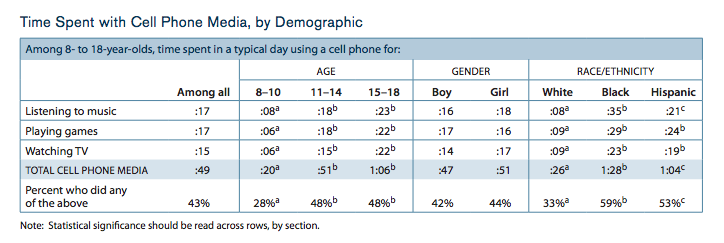
During S. Craig Watkins’ connectedlearning.tv session, he explained that Black and Hispanic teens spent more time on mobile devices than White teens. Watkins, a principal investigator of the Connected Learning Research Network and a teacher at the University of Texas, called this a “mobile paradox,” a seeming contradiction to the digital divide. Though they are more likely to live in homes without broadband access, Black and Hispanic teens are bridging the access gap using mobile devices. A recent Pew Internet study reports the same:
Among smartphone owners, young adults, minorities, those with no college experience, and those with lower household income levels are more likely than other groups to say that their phone is their main source of internet access.
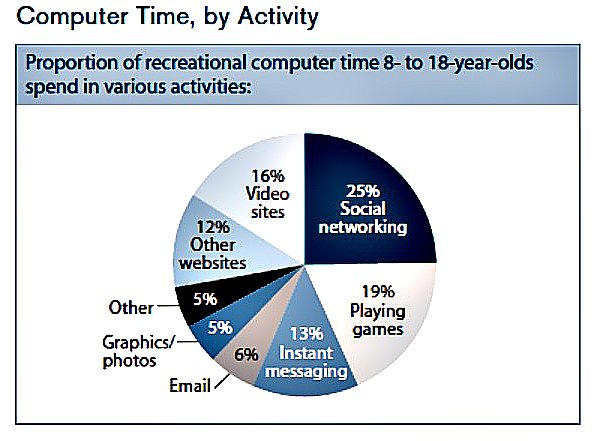
In the many links below the archived video of Watkins’ session on connectedlearning.tv is a link to the Kaiser Family Foundation’s Generation M2 study. As I read through that one, I found it curious that the study only categorized time spent with cell phone media three ways: listening to music, playing games, and watching TV. (Here’s the chart.)# On the other hand, the study categorized computer use in eight ways. (Here’s that chart.)
This raised a few questions for me. First, why paint such a limiting picture of mobile media use on cell phones when these devices support all of the practices attributed to computer time? Just by approaching the different devices this way, the report suggests a disparity of media practices that may not exist. I also wondered, looking at this pie chart, how can researchers make the distinction between “social networking” and these other media practices, many of which take also take place on social networks. YouTube probably qualifies as a video site, but it also is a social network. On Facebook- the social network- users play games, instant message one another, and create, edit and share photos and videos. “Social networking” is such a general verb, that it really only identifies the platform on which teens might interact with peers and media. Especially as teachers endeavor to explore interest-driven practices of youth with digital tools, we can continually refine how we examine those practices.
Recently, in a 12th grade English classroom, I asked students to navigate between two different types of sites while researching to prepare for debates. I wanted them to begin their research on the New York Times Room for Debate page, so I showed them how the site worked and asked them specifically to read the introduction of a high-interest topic. Next, they had to read each of the expert articles associated with the topic. A week or so later, I sent them to a different site, Debate.org. This time, I asked students to find examples of strong and weak online debates. Instead of explaining how the site worked, I asked them to explain it to me. I liked the assignment because it moved us away from the familiar discourse about these types of sites, where we identify one as informal, and therefore bad, and one as a formal site from a reputable publisher, therefore good. Certainly, we needed college-bound seniors to know that they cannot cite Debate.org in their research papers. Also, they had to know that the authors selected by the New York Times had a certain amount of credibility deriving from this publication, if not for their credentials under their bylines. Rather than stopping here with our consideration of the sites, though, I hoped they would see that Debate.or is a social network where people engage in competitive debates of varying seriousness and political correctness. The New York Times, of course, is the New York Times. This online, 21st Century version of the venerable newspaper is increasingly participatory and has many elements of a social network, too. In the 12th grade classroom, we wanted students to see that the sites differ in the level to which they invite participation. If I read the New York Times and do not comment, vote or debate, I'm a reader. If I read Debate.org and I don't debate, comment or vote, I'm a noob, or a lurker. Something these seniors and I obseved in our work is that some participants on Debate.org formulate better arguments than the experts invited to write for the Times. Students would read some expert articles and come away with no more information about their topic. Ironically, some of the arguments on Debate.org proved to be models of strong inline citation and link students to credible research about their topics. Readers have to filter more strategically in Debate.org, lest they spend their time reading an informal debate that consists entirely of “Your momma” jokes. So, filtering strategies were key, as indicated in the reflection written by Jacob, a student who successfully navigated the site. He wrote:
While I was siphoning through the challenges, I have acquired a basic working knowledge of how the site works and what can be done with the site. During my search the most well supported debate was a debate arguing whether or not the Muslim religion endorsed terrorism. The least supported debate was a joke debate that lacked any real knowledge of the subject to be funny.
His critical thinking helped me decide that the exploration of a social network had benefits and I was glad that our research and preparation for class debates took students to a virtual space not normally travelled in an English class.
I’ll be blogging in response to a webinar series offered by connectedlearning.tv at the invitation of the National Writing Project’s Digital Is.
Maybe the most inspiring thing about listening to Antero Garcia, a young teacher who has pushed on the boundaries of pedagogy in a very difficult teaching environment, is that words like “problem” and “challenge” seem to have only the best connotations when he says them.In this week’s connectedlearning.tv webinar, Garcia detailed some projects he has lead in his high school English class in south central Los Angeles. He shared his thinking about technology in schools and participatory learning. He also described a detailed game his students played which they later opened up to the larger community. After he did all of this, he asked a question:
He asked the connected learning community, "How do we do this with teachers who aren't necessarily oriented toward (game design) practices?"Garcia explained that he’s helping plan a new public high school in South Central Los Angeles, the Critical Design and Gaming School. His concern is that the school will be staffed with veteran teachers who might not have any interest in the type of pedagogy the new school hopes to employ.
As fascinated as I was by the air quality problem he posed to his English class, this problem- starting a school- strikes me as infinitely more interesting and exciting- not to mention difficult- than solving air quality problems in LA.
Here are three ways I would frame the challenges he faces:
1 How can you incorporate game design into professional learning, instructional planning and community development so teachers begin to connect game design with tangible learning? For teachers who have never attended schools built on game principles, applying game theory to teaching will be very hard, especially if they have not learned a great deal in their lives from playing games. Since opening a new school will be a huge learning experience for every staff member involved (just ask someone who has opened a school), this is an opportunity to put your pedagogy to the test with adults.
2 What are some ways you can temper your commitment to the project- and to change- with a gentle voice and and a welcoming ear that honors the experiences of veteran teachers? In his book Instructional Coaching: A partnership approach to improving instruction, Jim Knight compares the delicate task of asking teachers to change with going over to your sister’s house and asking her to change her parenting. Your new school will symbolize in many ways the idea that teaching practices ought to change. This will sound like a criticism to many. How can you keep those folks involved?
3 Can you solicit dissent to better inform your overall design? Since you endeavor to rethink pedagogy and reform education, you need everyone’s best thinking, not just the small group of technophiles, or the passionate gamers who may teach in your school. How can you keep critical thinking at the forefront of your work with staff?
I’ll be blogging in response to a webinar series offered by connectedlearning.tv at the invitation of the National Writing Project’s Digital Is.
After watching latest web session on connectedlearning.tv in which Erin Knight of Mozilla discussed the company’s vision for their Open Badge infrastructure, I discovered that Knight’s guarded optimism about the project was contagious. Here are three reasons I can get excited about open badges:
Badges might help us rethink motivation and learning
Knight commented in the web session that the binary view of intrinsic and extrinsic motivation is too restrictive for learning. By recognizing interest-driven learning through badges, we can study motivation in spaces where learners have a great deal more time, autonomy and support than schools can provide. This new conversation about badges could spark a new conversation about learning and motivation.
Badges might help us recognize the learning students do outside of the classroom and employ meaningful measurements
Students learn a great deal in spaces outside of the classroom and often do not see those as important learning experiences. A badge system might help students see themselves as learners by calling attention to learning that occurs in after school clubs, hobbies or recreational programs. Additionally, by inviting adult experts to use alternative measures to assess learning in a variety of places and spaces, we invite communities to think with educators about meaningful assessment that matters. At a time when people have ready access to the grades for their local schools determined by standardized tests, badges provide a welcome opportunity to rethink assessment criteria and learning. Might badges open the door for communities to think about qualifying the learning kids do rather than quantifying it?
Badge may popularize PLNs
Badge programs may help to popularize personal learning networks (PLNs), an emerging concept in online professional development for educators. More and more teachers have embraced online networks as powerful collaborative learning opportunities. By working online, teachers connect with colleagues and experts around the world to pursue learning that is relevant to them. A badge program like Mozilla’s may be a tipping point that allows educators who believe in self-directed, collaborative learning to open students’ eyes to a new approach to interest driven learning.